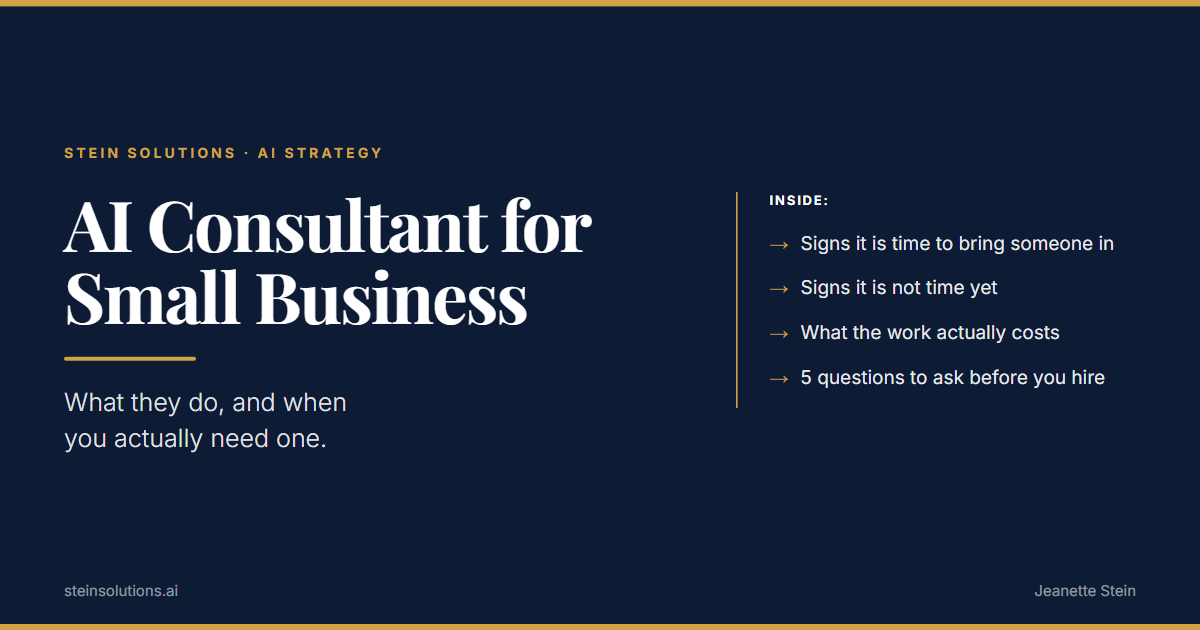
An AI consultant for a small business helps you decide where AI fits, what to build first, and how to set it up so your team will actually use it. The good ones spend more time on your business than on the technology.
Here is what the work looks like, and how to tell whether you need it yet.
What an AI consultant actually does
- Looks at how your business really runs before recommending anything
- Finds the handful of places AI would save real hours, and names the one to do first
- Builds the thing, or builds it alongside your team, instead of handing you a slide deck
- Sets the rules for what AI is allowed to do on its own and what stays with a person
- Gets your team using it, which is where most projects quietly die
- Leaves you able to run it without them
What a good one will not do
- Recommend AI for every part of your business. Some things should stay human, and a consultant worth hiring will tell you which
- Start building before understanding how you make money
- Sell you a stack of tools you did not ask about
- Leave you dependent on them to change a single thing
Signs it is time to bring someone in
- Your team is already using AI, in their own way, with no shared rules
- One person holds knowledge in their head and everything waits on them
- You have tried a few AI tools and none of them stuck
- The same information gets typed into three systems
- You know AI could help, and you do not have the hours to figure out where
- You are about to spend real money and want it aimed correctly the first time
Signs it is not time yet
Worth saying plainly, because it will save you money:
- The process you want to automate is broken. Fix it first, or you will scale the mess
- Nobody on your team has time to be involved. These projects need one internal person with real hours
- You want AI to solve a people problem. It will not
- You are shopping because competitors are, not because something in your business hurts
If you are in that second group, the more useful next step is choosing your first AI project yourself, or reading how to add AI to your operations without losing control.
What it costs
The cost of this work is set by the size of the problem, not by an hourly rate.
What moves the investment:
- How many people, departments, and locations the work touches
- Whether you already know what needs building, or need help deciding
- How much company knowledge has to be collected and organized first
- Whether existing systems need to be connected to each other
- How much testing and customization daily use will require
- Whether your team needs training and continued support
A business connecting one workflow should not pay for a company-wide partnership. A company with several departments and years of undocumented knowledge should not expect one automation to solve the larger problem. The scope comes out of the first conversation, and the number follows the scope.
Five questions worth asking before you hire anyone
- What would you tell me not to build?
- Who on my team will be able to run this when you are gone?
- What happens to our data, and can you show me where it goes?
- Show me something you built for a business my size.
- What does month four look like if we do nothing else?
MIT's 2025 State of AI in Business study found that 95% of enterprise pilots delivered no measurable return, and that the failures were operational rather than technical. Unclear goals, weak integration into real work, no one owning it. That is the part a consultant is actually for.
If you decide the answer is yes, AI consulting for small businesses covers what that engagement actually looks like.
Trying to decide if it is time to bring someone in?
Book a 30-minute strategy call. We will look at where AI fits your business, what comes first, and whether you need help at all.
Book a Strategy Call →